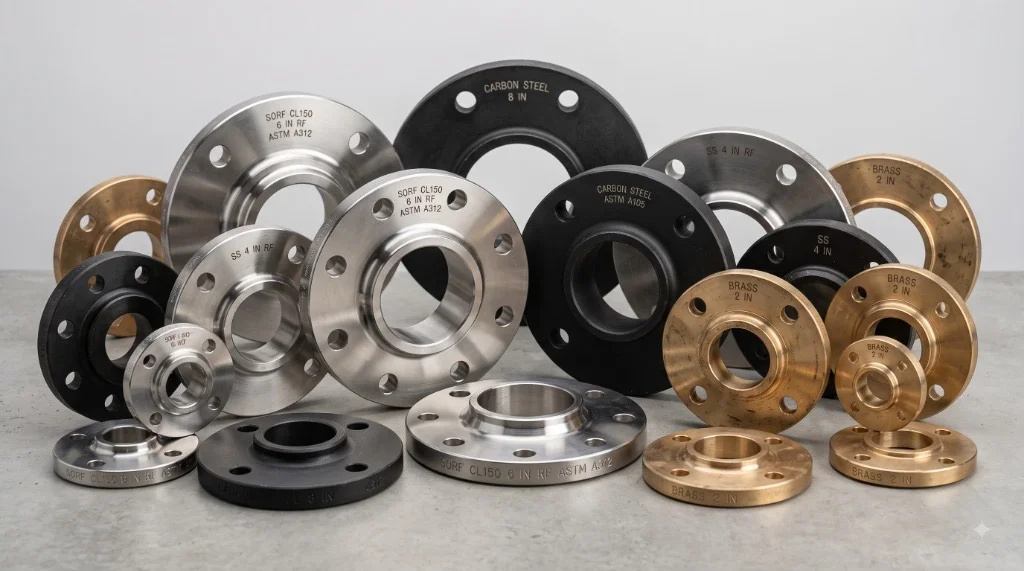
The Complete Engineering & Procurement Guide for Slip-On Raised Face (SORF) Industrial Flanges
Size Range1/2" to 60" NB
Pressure ClassesClass 150 to 2500
Key GradesA105N, SS316L, 2205
StandardsASME / EN / BIS
Origin / HubMumbai, India
Slip-On Raised Face (SORF) flanges represent one of the most widely specified and cost-effective pipe connection components in modern industrial fluid handling. Across petroleum refining complexes, chemical processing plants, municipal water grids, thermal power stations, and offshore marine infrastructure, SORF flanges provide a dependable, easily aligned, and structurally resilient flanged joint. However, for engineering procurement managers, piping designers, and EPC (Engineering, Procurement, and Construction) contractors operating in India and global export markets, sourcing high-grade SORF flanges requires navigating a complex matrix of dimensional tolerances, pressure-temperature ratings, metallurgical grades, welding requirements, and mill certification standards.
India—and specifically the industrial manufacturing and warehousing corridor of Mumbai and Maharashtra—serves as a primary global hub for forged steel flanges. Leading SORF flanges manufacturers in India produce precision-machined and forge-tested flanges adhering strictly to American Society of Mechanical Engineers (ASME), ASTM International, European Standards (EN/DIN), and Bureau of Indian Standards (BIS) specifications. This comprehensive guide delivers an exhaustive technical breakdown of SORF flanges, covering mechanical anatomy, dimensional specifications, metallurgical grades, dual-fillet welding guidelines, quality inspection protocols, and practical B2B procurement strategies through verified Indian supply networks.
Need Immediate Factory-Direct Pricing for Industrial Flanges?
Connect directly with verified SORF flanges manufacturers in India and Mumbai stockists for Class 150 to Class 2500 Slip-On Raised Face flanges in Carbon Steel, Stainless Steel, and High-Nickel Alloys with EN 10204 3.1 MTC.
What Is a SORF Flange? (Anatomy, Mechanism & Working Principle)
A SORF Flange (Slip-On Raised Face Flange) is a forged or plate-machined pipe flange designed to slide directly over the outer diameter of a mating pipe. The inside diameter (bore) of a slip-on flange is precision-bored slightly larger than the nominal outside diameter of the matching pipe. This design allows the pipe to slip smoothly into the flange bore until it reaches a designated setback position, after which it is secured to the pipeline using two fillet welds—one applied externally at the flange hub/back and one applied internally near the flange face.
💡
Featured Snippet Definition:
A SORF Flange (Slip-On Raised Face) is an industrial pipe flange that slips over the end of a pipe and is secured with internal and external fillet welds. It features a raised face (RF) sealing surface (1/16" or 1/4" high) with concentric or spiral serrations designed to concentrate bolting pressure onto a gasket for a leak-proof seal in low-to-medium pressure piping systems.
Understanding the Slip-On (SO) Configuration
Unlike Weld Neck (WN) flanges that feature an extended tapered hub welded butt-to-butt with the pipe wall, the Slip-On configuration does not require high-precision pipe end beveling. Key operational characteristics of the slip-on design include:
⚙️ Effortless Axial Alignment
The pipe slides easily into the flange bore, allowing fabricators to adjust rotational orientation and bolt-hole alignment in the field before laying down weld beads.
⏱️ Reduced Fit-Up Prep Time
Pipes can be cut square with standard mechanical saws or plasma cutters without requiring time-consuming 37.5° J-groove or V-bevel edge machining.
🛡️ Dual Fillet Weld Strength
Because the pipe is anchored by both an outer fillet weld at the hub and an inner fillet weld inside the bore, the joint achieves high mechanical rigidity against internal hydrostatic pressures.
Significance of the Raised Face (RF) Sealing Surface
The "Raised Face" (RF) is the most common facing type specified for slip-on flanges under ASME B16.5 standards. In an RF flange, the gasket seating area is physically raised above the surrounding bolting circle plane:
Standard Height DimensionsASME B16.5 Specs
For ASME Class 150 and Class 300 flanges, the raised face is standardized at 1/16 inch (1.6 mm). For high-pressure classes (Class 400, 600, 900, 1500, and 2500), the raised face height increases to 1/4 inch (6.4 mm) to accommodate heavier gasket seating stresses.
Gasket Load ConcentrationSealing Physics
By elevating the contact area above the bolt circle, the entire clamping force exerted by the tightened studs is concentrated onto a relatively small, defined gasket surface. This creates a superior mechanical seal without transferring unnecessary compressive stress to the outer flange rim.
Surface Serration StandardsRa 3.2 – 6.3 μm
The raised face is precision-machined with phonographic spiral or concentric grooves having a surface roughness typically between 125 to 250 micro-inches AARH (Ra 3.2 to 6.3 μm) for standard non-metallic and spiral-wound gaskets. These micro-serrations bite into the gasket material, preventing radial blowout under fluctuating fluid pressures.
SORF vs. WNRF vs. SOFF vs. SWRF: Technical Comparison Matrix
Selecting the proper flange configuration is a critical engineering decision that dictates piping fatigue life, total fabrication cost, and inspection compliance. Below is an engineering comparison matrix contrasting SORF flanges against alternative industrial flange types commonly manufactured in India:
Cast iron pump casings, water treatment, low-pressure HVAC
Chemical injection skids, hydraulic lines, instrument air
When to Specify SORF Flanges Over Weld Neck (WNRF)
While Weld Neck flanges are mandatory for extreme cyclical thermal fatigue, severe corrosive erosion, or critical lethal service pipelines where 100% volumetric radiography is specified, SORF flanges remain the premier choice under the following project conditions:
💰 1. Budget & Capex Constraints
The initial purchase cost is typically 20% to 35% lower than WNRF because it requires less raw forging mass and eliminates the extended tapered neck.
📐 2. Restricted Space Envelopes
In modular process skids, shipboard machinery rooms, and tight utility corridors, the absence of a long neck allows SORF flanges to fit within tight spatial dimensions.
⚡ 3. Simplified Fabrication Protocols
Welders can rapidly cut pipes to length without setting up dedicated pipe-end beveling machines on site, significantly reducing field installation labor hours.
💧 4. Medium & Low-Pressure Utility
For auxiliary cooling water lines, fire suppression loops, compressed air lines, inert gas blankets, and wastewater grids, SORF flanges provide dependable containment.
Manufacturing Standards & ASME Dimensions by SORF Flanges Manufacturers in India
Leading SORF flanges manufacturers in India fabricate precision slip-on raised face flanges in compliance with major domestic and international dimensional and pressure-temperature standards. When preparing an RFQ or engineering purchase specification, buyers should reference the applicable standard from the list below:
Primary International & Indian Standards
ASME B16.5NPS 1/2" to 24"
Standard specification for Pipe Flanges and Flanged Fittings covering sizes from NPS 1/2" through NPS 24" across Pressure Classes 150, 300, 400, 600, 900, 1500, and 2500.
ASME B16.47 (Series A & Series B)NPS 26" to 60"
Standard for Large Diameter Steel Flanges covering NPS 26" through NPS 60" (Series A corresponds to MSS SP-44; Series B corresponds to API 605).
EN 1092-1 / DIN StandardsPN 6 to PN 40
European flanged specifications for metric systems covering Type 01 (Plate Slip-On) and Type 12 (Hubbed Slip-On) rated from PN 6, PN 10, PN 16, PN 25, to PN 40.
BS 10 (Tables D, E, F, H)British Standard
British dimensional standards widely utilized across historic Commonwealth municipal water pipelines, agricultural grids, and fire networks.
IS 2062 / IS 6392BIS Certified
Bureau of Indian Standards (BIS) specifications for structural steel and plate carbon steel flanges for general fluid transmission.
AWWA C207Waterworks Standard
American Water Works Association standard for large-bore carbon steel slip-on ring and hub flanges in waterworks service (Classes B, D, E, F).
ASME B16.5 Class 150 & Class 300 SORF Flange Dimensions & Weight Chart
Below is a standardized engineering reference table showing dimensions and approximate weights for ASME B16.5 Class 150 and Class 300 SORF flanges from NPS 1/2" to NPS 24":
Nominal Pipe Size (NPS)
Pipe OD (mm)
Flange OD (mm) Cl.150
Flange Bore ID (mm)
PCD (mm) Cl.150
No. Bolts × Dia (Inches)
Approx. Wt (kg) Cl.150
Approx. Wt (kg) Cl.300
1/2" (15 NB)
21.3
88.9
22.4
60.5
4 × 1/2"
0.50
0.70
3/4" (20 NB)
26.7
98.6
27.7
69.9
4 × 1/2"
0.70
1.20
1" (25 NB)
33.4
108.0
34.5
79.2
4 × 1/2"
0.90
1.40
1-1/4" (32 NB)
42.2
117.3
43.2
88.9
4 × 1/2"
1.20
1.90
1-1/2" (40 NB)
48.3
127.0
49.5
98.6
4 × 1/2"
1.40
2.70
2" (50 NB)
60.3
152.4
61.7
120.7
4 × 5/8"
2.30
3.20
2-1/2" (65 NB)
73.0
177.8
74.4
139.7
4 × 5/8"
3.60
4.50
3" (80 NB)
88.9
190.5
90.7
152.4
4 × 5/8"
4.10
5.90
4" (100 NB)
114.3
228.6
116.1
190.5
8 × 5/8"
5.90
10.40
5" (125 NB)
141.3
254.0
143.8
215.9
8 × 3/4"
6.80
12.70
6" (150 NB)
168.3
279.4
170.7
241.3
8 × 3/4"
7.70
17.70
8" (200 NB)
219.1
342.9
221.5
298.5
8 × 3/4"
12.70
26.30
10" (250 NB)
273.0
406.4
276.4
362.0
12 × 7/8"
18.60
36.70
12" (300 NB)
323.8
482.6
327.2
431.8
12 × 7/8"
29.00
52.20
14" (350 NB)
355.6
533.4
359.2
476.3
12 × 1"
39.00
74.80
16" (400 NB)
406.4
596.9
410.5
539.8
16 × 1"
49.00
104.30
18" (450 NB)
457.2
635.0
461.8
577.9
16 × 1-1/8"
54.40
127.00
20" (500 NB)
508.0
698.5
513.1
635.0
20 × 1-1/8"
68.00
154.20
24" (600 NB)
609.6
812.8
616.0
749.3
20 × 1-1/4"
95.30
226.80
Looking for Custom Sizes, Higher Pressure Classes, or Non-Standard Bores?
Steel Mumbai's verified supplier network fabricates Class 600, 900, 1500, and large-diameter ASME B16.47 SORF flanges tailored to your custom engineering drawings.
Material Grades & Metallurgical Specifications
The operational longevity and corrosion resistance of a SORF flanged joint depend directly upon selecting the correct metallurgical alloy. Certified SORF flanges manufacturers in India forge precision slip-on flanges from fully tested ingots and billets across five major material families:
Carbon steel represents the backbone of standard industrial piping systems, offering high mechanical tensile strength and superior ductility at an economical price point:
ASTM A105 / A105N: The universal industry standard for forged carbon steel piping components operating in ambient to high-temperature service (-29°C to 425°C). Normalized (A105N) heat treatment is standard for refined grain structure and enhanced low-temperature notch toughness.
ASTM A350 LF2 (Class 1 & 2): Forged low-temperature carbon steel (LTCS) engineered specifically for cryogenic and cold-climate operations with mandatory Charpy V-notch impact testing down to -46°C.
ASTM A694 (Grades F42, F52, F60, F65, F70): High-yield carbon steel forgings used extensively in cross-country oil, natural gas, and hydrocarbon transmission pipelines.
IS 2062 Grade E250 / E350: Indian Standard structural carbon steel plates used for economical low-pressure water and non-hazardous structural piping.
A105NA350 LF2A694 F52A694 F65IS 2062 E250
2. Stainless Steel SORF FlangesCorrosion & Chemical Resistant
Stainless steel grades provide exceptional resistance against generalized corrosion, atmospheric oxidation, and acidic or alkaline chemical attack:
ASTM A182 Grade F304 / F304L (UNS S30400 / S30403): 18/8 Austenitic stainless steel widely utilized across food processing, dairy, beverage, municipal water treatment, and commercial architectural plumbing. The low-carbon "L" grade prevents chromium carbide precipitation during welding.
ASTM A182 Grade F316 / F316L (UNS S31600 / S31603): Molybdenum-bearing (2.0% to 3.0% Mo) austenitic stainless steel delivering superior resistance against localized chloride pitting, crevice corrosion, and acidic processing environments in chemical and marine systems.
ASTM A182 Grade F321 / F347: Titanium-stabilized (F321) and Niobium-stabilized (F347) stainless steels engineered for sustained high-temperature operations (400°C to 800°C) such as boiler exhaust manifolds and refinery furnace loops.
ASTM A182 Grade F310S: High chromium-nickel alloy designed for extreme high-temperature oxidation resistance up to 1150°C in kiln and heat-treatment furnace headers.
Featuring an optimized 50/50 dual-phase microstructure of austenite and ferrite, duplex alloys offer double the yield strength of standard 316 stainless steel combined with superior resistance to stress corrosion cracking (SCC):
ASTM A182 Grade F51 / F60 (Duplex 2205 - UNS S31803 / S32205): Ideal for offshore marine platforms, seawater cooling mains, desalination plants, and petrochemical bleaching plants.
ASTM A182 Grade F53 / F55 (Super Duplex 2507 - UNS S32750 / S32760): High PREN (≥ 42) alloy capable of withstanding extreme chloride concentrations, deep-sea oil extraction lines, and aggressive flue-gas desulfurization (FGD) systems.
Duplex 2205Super Duplex 2507UNS S31803UNS S32750
4. Alloy Steel (Chrome-Moly) SORF FlangesHigh Temperature & Creep Strength
Chromium-Molybdenum alloy forgings engineered to maintain creep rupture strength, structural hardness, and thermal resistance in superheated environments:
ASTM A182 Grade F11, F22, F5, F9, F91: Chromium-Molybdenum alloy forgings engineered to maintain creep rupture strength, structural hardness, and thermal resistance in superheated steam headers, power plant boiler circuits, and catalytic cracking refinery loops.
Correct mechanical fit-up and welding execution are crucial to ensure that a SORF flanged connection achieves its calculated pressure rating without suffering premature weld fatigue or flange face warping. Fabrication must adhere to ASME B31.3 (Process Piping Code) Section 328.5.2 and ASME Section IX welding qualifications.
⚠️
1. The Pipe Setback Distance (Gap Rule):
When inserting the pipe into the bore of a SORF flange, the pipe end must never be set flush with the raised face. Instead, fabricators must maintain a mandatory setback gap:
The Standard Setback Formula: The distance between the pipe end and the flange raised face should equal the nominal pipe wall thickness (t) plus approximately 3 mm (1/8 inch), or a minimum of 6 mm (1/4 inch) for standard pipe schedules.
Why the Setback Is Mandatory:
1. Weld Clearance
It provides sufficient room to lay down a full, uniform inside fillet weld bead without letting the weld pool spill over or score the precision-machined raised face.
2. Thermal Isolation
It isolates the gasket seating area from intense heat-affected zone (HAZ) metallurgical transformation, preventing thermal warping and flange face distortion.
3. Gasket Seating Clearance
It ensures that when the mating flange is bolted and compressed against the gasket, the pipe end does not physically bottom out against the mating gasket or opposing pipe end.
2. Dual Fillet Weld Execution
🔘 External Fillet Weld (Hub to Pipe)
Applied along the outer hub shoulder where the flange meets the pipe OD. The minimum throat thickness of this weld must equal 1.4 × nominal pipe wall thickness (1.4t) or the thickness of the flange hub, whichever is smaller. This external weld bears the primary axial tension and bending moments of the pipeline.
🔘 Internal Fillet Weld (Bore to Pipe End)
Applied inside the bore around the pipe end. The minimum throat thickness must equal the pipe wall thickness (t) or 6 mm (1/4 inch), whichever is smaller. This internal weld provides secondary mechanical anchoring and seals the crevice against internal fluid corrosion.
Quality Assurance & Testing Protocols Followed by SORF Flanges Manufacturers in India
Certified SORF flanges manufacturers in India enforce rigorous Quality Management Systems (QMS) certified to ISO 9001:2015 and Pressure Equipment Directive (PED 2014/68/EU). When procuring SORF flanges for critical projects, buyers must verify compliance through the following inspection battery:
Performed using handheld X-ray Fluorescence (XRF) or Optical Emission Spectrometry (OES) analysers on 100% of alloy and stainless steel flanges to verify precise chemical composition (Cr, Ni, Mo, Ti content) before dispatch.
Hydrostatic Pressure Testing
Flange assemblies are hydro-tested in accordance with ASME B16.5 Section 2.6 at 1.5 times the 38°C (100°F) pressure rating to verify pressure containment integrity.
Ultrasonic Testing (UT)
Performed on raw forged billets and finished heavy-wall flanges in accordance with ASTM A388 to detect internal voids, forging bursts, slag inclusions, or laminar defects.
Liquid Penetrant (DPT) & Magnetic Particle (MPI)
Applied to the machined sealing face, bolt holes, and fillet weld bevels to verify complete absence of surface micro-cracks or pinholes.
Intergranular Corrosion (IGC) Testing
Conducted per ASTM A262 (Practice E / Practice A) on stainless steel batches to confirm resistance to intergranular attack.
Dimensional Tolerance Check
Verification of Outside Diameter (OD), Bolt Circle Diameter (PCD), Bolt Hole Spacing, Bore Diameter, and Raised Face Serration Finish (Ra 3.2–6.3 μm) using calibrated vernier micrometers and surface roughness testers.
2. Mill Test Certificate (MTC EN 10204 Type 3.1 & 3.2)
Every shipment of SORF flanges from verified Indian suppliers must be accompanied by an authentic Mill Test Certificate conforming to EN 10204 Type 3.1 (validated by the manufacturer's independent QA inspector) or EN 10204 Type 3.2 (co-certified by an independent Third-Party Inspection Agency). The MTC must clearly state:
Impact test values (Joules at specified sub-zero temps for LTCS/Duplex)
NDT results & Hydrostatic pressure test validation
3. Third-Party Inspection (TPI) Agencies
For high-stakes EPC projects in oil & gas and power sectors, Indian manufacturers routinely coordinate inspections with globally recognized Third-Party Inspection Agencies based in Mumbai, including TÜV SÜD / TÜV Rheinland, Bureau Veritas (BV), DNV, Lloyd's Register (LR), SGS, and Engineers India Limited (EIL).
Wholesale Price Benchmarks from SORF Flanges Manufacturers in India
Mumbai, Maharashtra functions as the commercial epicenter and primary distribution corridor for India's steel and piping industry. By sourcing directly from leading SORF flanges manufacturers in India with centralized stockyards in Mumbai (Khetwadi, Kalbadevi, Loha Bhavan, CST, and Taloja MIDC), EPC procurement teams can bypass middleman markups and secure immediate stock dispatch.
Indicative Price Benchmark from SORF Flanges Manufacturers in India (2026 Baseline)
The following table outlines indicative wholesale price ranges per piece for standard Class 150 SORF flanges across popular material grades in Mumbai:
Size (NPS)
Carbon Steel A105 (INR / Piece)
SS 304 / 304L (INR / Piece)
SS 316 / 316L (INR / Piece)
Duplex 2205 (INR / Piece)
1/2" (15 NB)
₹ 65 – ₹ 95
₹ 160 – ₹ 220
₹ 240 – ₹ 320
₹ 450 – ₹ 600
1" (25 NB)
₹ 90 – ₹ 140
₹ 240 – ₹ 330
₹ 360 – ₹ 480
₹ 680 – ₹ 900
2" (50 NB)
₹ 210 – ₹ 290
₹ 520 – ₹ 700
₹ 780 – ₹ 1,020
₹ 1,450 – ₹ 1,900
3" (80 NB)
₹ 360 – ₹ 480
₹ 880 – ₹ 1,150
₹ 1,300 – ₹ 1,680
₹ 2,400 – ₹ 3,100
4" (100 NB)
₹ 520 – ₹ 690
₹ 1,280 – ₹ 1,650
₹ 1,880 – ₹ 2,420
₹ 3,500 – ₹ 4,500
6" (150 NB)
₹ 780 – ₹ 1,050
₹ 1,950 – ₹ 2,500
₹ 2,850 – ₹ 3,650
₹ 5,200 – ₹ 6,800
8" (200 NB)
₹ 1,350 – ₹ 1,850
₹ 3,400 – ₹ 4,300
₹ 4,900 – ₹ 6,200
₹ 9,200 – ₹ 11,800
10" (250 NB)
₹ 2,100 – ₹ 2,850
₹ 5,200 – ₹ 6,600
₹ 7,600 – ₹ 9,500
₹ 14,000 – ₹ 18,000
12" (300 NB)
₹ 3,200 – ₹ 4,300
₹ 7,800 – ₹ 9,900
₹ 11,400 – ₹ 14,200
₹ 21,000 – ₹ 27,000
*Note: Prices are indicative wholesale market rates per piece (ex-works Mumbai) excluding GST, freight, and special third-party inspection fees. Bulk volume orders (>100 pieces) qualify for tiered commercial discounts.
Step-by-Step B2B Procurement Checklist for Industrial Buyers
To eliminate procurement delays, avoid counterfeit test certificates, and ensure seamless delivery for your industrial projects, follow this structured procurement checklist when ordering from SORF flanges manufacturers in India:
1
Define the Exact Engineering Standard
Specify whether your project requires ASME B16.5 (for NPS ≤ 24"), ASME B16.47 Series A / Series B (for NPS ≥ 26"), EN 1092-1, or IS 2062.
2
Clarify Pressure Class & Facing Type
Specify the pressure rating (Class 150, 300, 600, etc.) and confirm the raised face height (1/16" for Class 150/300; 1/4" for Class 600+) with standard serration finish (125–250 AARH).
3
Specify Precise Material Specification & Grade
Clearly designate the ASTM/ASME forging code (e.g., ASTM A105N for normalized carbon steel, ASTM A182 F316L for dual-certified stainless steel).
4
State Pipe Schedule & Matching Bore
While SORF flanges slip over the outside of the pipe, matching the pipe outer diameter accurately ensures the internal weld throat meets ASME B31.3 requirements.
5
Mandate Quality Certification Level
Require EN 10204 3.1 MTC showing melt heat numbers, chemical composition, tensile/yield values, and hardness testing results.
6
Verify Vendor Credentials
Work exclusively with verified suppliers whose registered GSTIN, physical manufacturing facility, stockyard addresses, and ISO certifications are validated.
Frequently Asked Questions (FAQ)
1. What is the full form of SORF flange?
SORF stands for Slip-On Raised Face flange. "Slip-On" refers to the flange bore sliding directly over the outer diameter of the pipe, and "Raised Face" refers to the gasket sealing surface being elevated above the bolt hole circle to maximize sealing pressure.
2. Can SORF flanges be used for high-pressure applications?
SORF flanges are primarily engineered and standardized for low-to-medium pressure applications (ASME Class 150, Class 300, and Class 600). For severe high-pressure services (Class 900, 1500, 2500) or cyclical thermal shock environments, Weld Neck (WNRF) or Ring Type Joint (RTJ) flanges are recommended due to their higher fatigue strength and butt-weld geometry.
3. Why is internal welding required on a SORF flange?
Internal fillet welding secures the inner rim of the flange bore to the pipe end, sealing the internal annular gap between the pipe OD and flange bore. This prevents pressurized process fluids from entering the crevice, eliminating crevice corrosion and fluid bypass while reinforcing mechanical joint strength.
4. What is the difference between a SORF flange and a SOFF flange?
Both flanges share an identical slip-on body. However, a SORF (Raised Face) flange has an elevated gasket contact area that concentrates bolt clamping force onto a smaller gasket area, whereas a SOFF (Flat Face) flange has a completely flat face across its entire diameter, commonly bolted to brittle cast iron, bronze, or fiberglass components to prevent cracking the flange rim during bolt torquing.
5. What documentation do SORF flanges manufacturers in India provide?
Reputable SORF flanges manufacturers in India provide comprehensive compliance documentation, including an authentic Mill Test Certificate (MTC) conforming to EN 10204 3.1, Heat Number traceability markings stamped on the flange rim, Positive Material Identification (PMI) inspection reports for alloy/stainless steel, and third-party inspection (TPI) release notes if specified by your client.
6. How quickly can verified Mumbai suppliers dispatch standard SORF flanges?
Because Mumbai is India's primary stocking hub, standard sizes (NPS 1/2" to 12" in Carbon Steel A105 and Stainless Steel 304/316 Class 150/300) are maintained in ready stock for immediate dispatch within 24 to 48 hours. Custom forgings, heavy wall thicknesses, or exotic alloys (Duplex, Inconel) typically require 7 to 15 business days for precision CNC machining and testing.
Connect with Verified SORF Flanges Manufacturers in India via Steel Mumbai
SteelMumbai.com connects mechanical engineering contractors, industrial fabricators, EPC project leaders, and global importers directly with top-tier SORF flanges manufacturers in India and certified stockists across Mumbai and Maharashtra.
Whether you require 50 pieces of 2" Class 150 A105 SORF flanges for an immediate utility maintenance shutdown or 1,000+ pieces of dual-certified ASTM A182 F316L flanges for a major chemical refinery project, Steel Mumbai simplifies your sourcing workflow. Request competitive quotations simultaneously from multiple audited manufacturers, compare rates transparently, verify authentic EN 10204 3.1 test certificates, and secure factory-direct pricing for your business.
Ready to Optimize Your Industrial Flange Procurement?
Submit your project Bill of Materials (BOM) today to receive fast, competitive, factory-direct quotations from verified Indian flange manufacturers.